
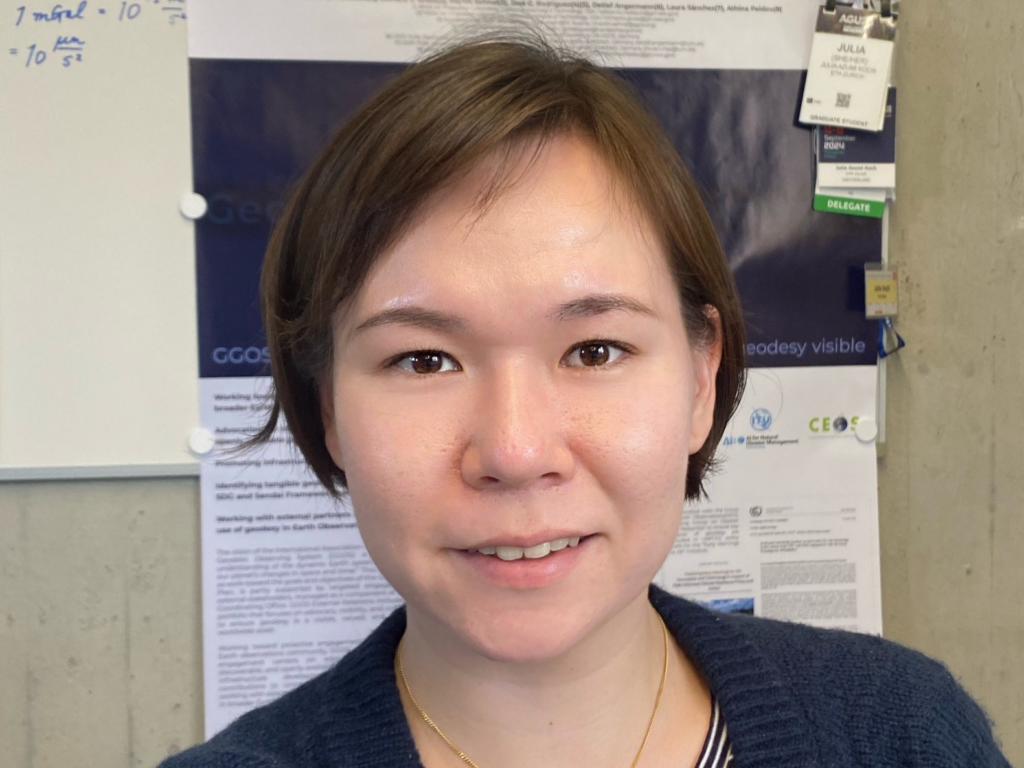

About Julia
Currently, she is in her final year of her PhD at ETH Zurich in Switzerland. Prior to this, she completed her Master’s degree at the Technical University of Munich in Germany, where she also earned her Bachelor of Science. As part of her Master’s program, Julia participated in an exchange semester at the University of Tokyo. Julia holds dual nationality: she is both German and Japanese. She enjoys attending conferences outside of Europe, as they provide opportunities to engage with individuals she may not encounter at European meetings.
Julia’s Involvement in IAG: How It Happened
During her studies, Julia completed internships at the TUM-DGFI (Deutsches Geodätisches Forschungsinstitut). While working on her Master’s, an opportunity arose for an Assistant Researcher position on a project with Laura Sanchez, who is now the president of GGOS (Global Geodetic Observing System). Julia was particularly interested in the GGOS’s efforts to enhance cooperation among stakeholders to ensure that geodetic results have a positive impact on society.
In 2022, Julia attended the “GGOS Days” meeting in Munich. She highlights that this open and free event provides a great opportunity for people to become involved in IAG. You can find recordings of the GGOS meetings on their YouTube channel: https://www.youtube.com/c/ggosglobalgeodeticobservingsystem
Following this, Julia was invited to become the GGOS Early Career Scientist (ECS) representative and also to serve as a representative for ECSNet. That is how Julia became involved in IAG!
Julia’s Research
Julia is working on the new reference system for CERN (European Organization for Nuclear Research). Every country typically establishes a so-called reference system to define the coordinates of every point within its territory. These coordinates are essential for various applications, such as the navigation system in your car to calculate the best route to your destination, the real estate cadaster to define the precise boundaries of properties, and cartographers to determine the heights of mountain peaks within the country.
CERN is preparing to build a new accelerator, which must be perfectly integrated into its existing infrastructure and meet exceptionally high alignment demands for its individual components. Since CERN is located on both French and Swiss territory, establishing a new reference system specifically for CERN is more practical than reconciling the differences between the two national systems. The challenges of the CERN project aligns with the objectives of the Joint Working Group 2.2.1 of Commission 2 – Gravity Field of the IAG.
Step Into Engagement:
Julia’s Advice for Getting Involved!
Julia emphasizes that joining the “GGOS Days” online offers a comprehensive overview of key topics within IAG, and she highly recommends attending in person if possible. She suggests that pursuing internships or working as a research assistant at research institutes or universities can be invaluable for building connections, as this experience often leads to quicker responses when people recognize you. Engaging with those involved in IAG activities enables you to develop your own ideas and projects, and fostering in-person interactions with researchers is crucial—it’s more effective than solely reading their publications. Additionally, Julia highlights that if you have ideas for promoting geodesy, the Early Career Scientists (ECS) are very receptive to new suggestions, and you are encouraged to reach out to them.
Julia’s contact
You can contact Julia (in English, German or Japanese): jukoch@ethz.ch