Interview with Felix Gerick
1. Could you share a bit about yourself and your career?
I come from Germany (Cologne area) and I studied Geophysics and Meteorology at the University of Cologne for my BSc and MSc (2012-2017), with a focus on anisotropic turbulence in solar wind plasma. For my PhD (11/2017-12/2020) I then moved to Grenoble to work on the transfer of angular momentum between the core and the mantle from torsional Alfvén waves. I worked together with Dominique Jault at ISTerre and with Jérôme Noir at ETH in Zurich, where I conducted half of my PhD. I also discovered so-called quasi-geostrophic Magneto-Coriolis waves that are able to explain interannual variations in the magnetic field.
2. What was your role in the project, and how long were you involved?
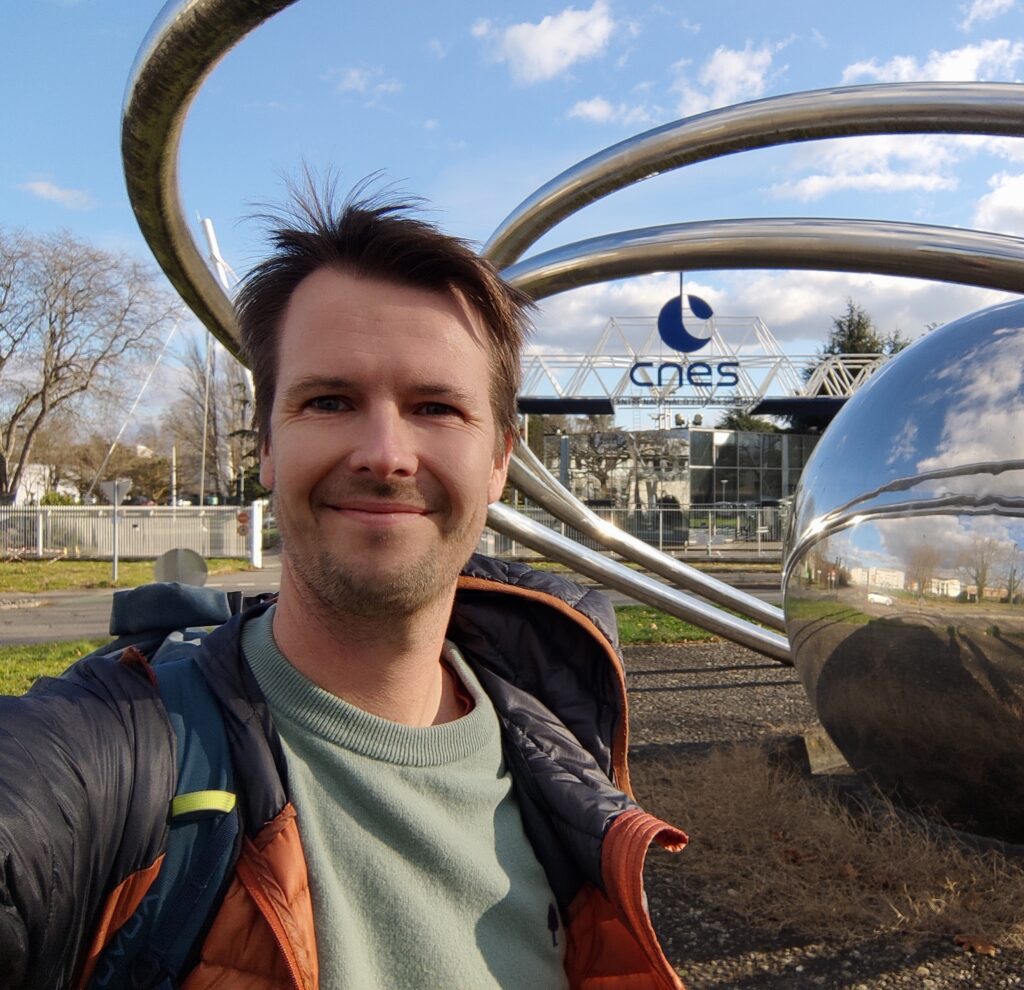
Postdoc for four years (2 years in Brussels, 2 years in Toulouse): after my PhD I moved to Brussels (01/2021-01/2023) as a postdoc in the GRACEFUL project with Veronique Dehant at ROB, working on the geomagnetic signature of interannual hydromagnetic waves in the Earth’s core. From 02/2023 to 01/2025 I was a postdoc in the GRACEFUL project located at CNES in Toulouse with Mioara Mandea. I continued my projects on hydromagnetic waves and also worked on the dynamic pressure of flows at the core’s surface, using geodynamo simulations.
3. What was the goal and results of your work in the GRACEFUL project?
The goal of my work was to better understand how waves in the Earth’s core can contribute to the changes in the magnetic field that recent satellite observations reveal. We have identified a certain type of wave (quasi-geostrophic Magneto-Coriolis wave) in flows at the surface of the Earth’s core. The presence of these waves in the Earth’s core suggests that no stable stratification (meaning a layer that is not mixed by convection) is needed at the top of the core, which was believed to be necessary to explain wave dynamics at these periods of a few years.
4. Beyond your research, did the project bring other benefits to your career, such as networking, conferences, or new opportunities?
I have been able to work closely with scientists from geodesy, who analyze gravimetric signals of the surface hydrology. This is an exciting subject that I would otherwise not have been able to link to my research on the Earth’s deepest interior.
Being able to collaborate and organize research between several international groups of different backgrounds has helped me to better put my research into the broader context. And of course, I have been able to attend several meetings and conferences throughout my four years within the grant.