
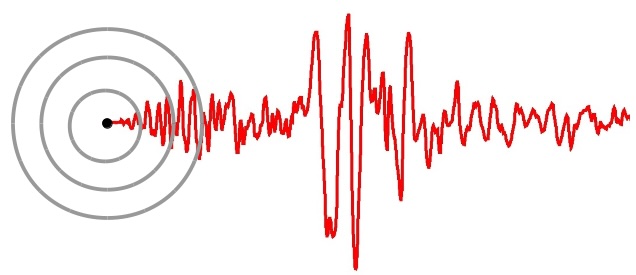
The project is entitled “Early magnitude estimation for earthquake hazard assessment” and related with IASPEI.
It has a R&D SEED grant (under special project scheme) funded by Council of Scientific and Industrial Research (CSIR), Govt. of India.
__________________________________________________________________________________________________________________________
The project “Early magnitude estimation for earthquake hazard assessment” started during March 2024 and will end by March 2026. The Principal Investigator is Dr. Nitin Sharma, Senior Scientist, CSIR-NGRI, Hyderabad, India.
The main goal is to understand the initial rupture processes of small to moderate sized earthquake in Himalayan region which occur frequently. This is done by evaluating the ground motion parameters (like peak displacements and effective duration) for rapid earthquake size estimation to evaluate seismic hazard in Himalayan region for early warning purposes.
Estimation of earthquake magnitude from very initial P-wave pulses of ground motion is the key problem for Earthquake Early Warning (EEW). Ground motion amplitudes and their effective duration just after the P-onset can be a good approach to derive true information of the earthquake size, especially when data is near field. The small and large magnitude earthquakes may have distinguished pattern from very beginning of rupture and hence understanding these characteristics can help in estimating the size of the earthquake and warrant the early warning. However on contrary many other studies found no difference during initial stages of earthquake nucleation. Therefore, this scientific problem is still an interesting question.
Through this project they are trying to understand how few couple of seconds of P-waves, are correlated with the magnitude with special focus on the Himalayan region. They have started with small to moderate sized earthquakes to understand the regional scaling meanwhile they are still exploring the methodology and state-of-art concept for large magnitudes.
Why is this research important?
This research is very important to address above mentioned scientific questions, especially in Himalayan region. Himalayas has experienced three catastrophic earthquakes with M>8.0 in past ; 1897 Shillong (M8.2); 1934 Bihar-Nepal (M8.4); and 1950 Assam-Tibet (M8.7) . These earthquakes has trolled thousands of lives and demolished thousands of structures. The recent major earthquakes of 2005 Kashmir (M7.6), and 2015 Gorkha-Nepal (M7.8) have underline the potential for future great earthquakes, particularly in seismic gaps regions of the fault that have not ruptured in recent history and may be accumulating strain. Therefore, there is always a need of new or improved regional seismic monitoring networks, understanding of strong ground motion parameters and development of regional ground motion models to better quantify and minimize associated uncertainties.
What is one key discovery and its challenges?
They found that peak displacement amplitude shows unbiased correlation with size of the earthquake and they developed first region specific median predictive model for by using 3 seconds of P-wave data. The 3-4s of data is great to determine the size of earthquakes with small to moderate magnitude range (M<6.5). But the key challenges they are facing are as follows:
- Large scattering in the data which is prominent in lower frequencies, with which it is difficult to control the uncertainties associated with model.
- The challenge is to accept/not accept the fact that 3-4s of data is not sufficient to determine of size of the earthquakes beyond M=6.5 as it lead to saturation of determined magnitudes using initial pulses of P-wave, hence can be under predicted.
Don’t miss next blog post featuring an interview with the ECS PI of this project!