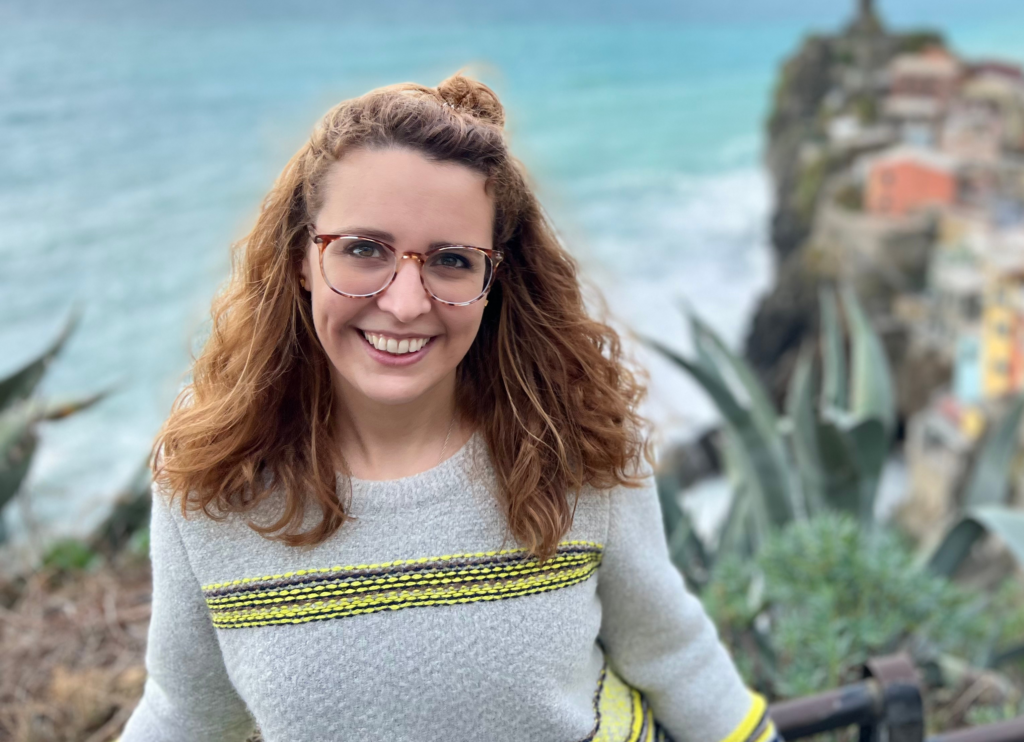

About Maria
Maria del Puy, or just María, originally from Spain, is pursuing her PhD at the University Complutense of Madrid in collaboration with GeoSphere Austria in Vienna. At GeoSphere Austria, she works on research and gives scientific advice on multi-hazard situations.
.
She holds a Master’s degree in Geodesy and Geomatics from the Technical University of Vienna and a five-year degree in Physics, specializing in Geophysics, from the University Complutense of Madrid.
What she most enjoys in her work is providing scientific guidance during disaster situations related to earthquakes as part of the European Commission’s Emergency Response Coordination Centre (ERCC). This aspect of her job allows her to make significant contributions to academia and society as a whole.
Maria’s Involvement in IASPEI: How It Happened
The researcher Barbara Leichter working at GeoSphere Austria invited Maria to participate in an interview for a film highlighting scientific advancements presented by IUGG at the 2023 conference in Berlin. This connection allowed Maria to network with other ECS members, enhancing her involvement and helping to establish a new ECS group focused on IASPEI, where she actively encouraged participation.
The group organizes social events, online meetings, and in-person gatherings during conferences. They also launched social media channels to share updates and news about conferences. You can find IASPEI on platforms such as Twitter (@IASPEI), Facebook, and Instagram, where they keep the community informed and engaged.
Maria’s Research
María’s research focuses on analyzing seismic sequences in the Vienna Basin, approximately 50 km southeast of Vienna, during the period from 2021 to 2024. Her work examines the spatial and temporal distribution of earthquakes, emphasizing accurate event localization using nonlinear methods, such as NonLinLoc (Lomax, 2009), and determining focal mechanisms through moment tensor inversion. This includes tools like the Seismic Analysis Code (SAC) and FocMec software for robust processing of seismic data. The study also quantifies critical seismic parameters like the b-value, which helps characterize regional seismicity based on the Gutenberg-Richter law.
Triggered by a new seismic series in the region, including an event near Gloggnitz with a local magnitude comparable to the mainshock in Breitenau (2021), María expanded her investigation. The added datasets, enriched by recent recordings, allowed her to refine location error estimates using statistical adjustments (e.g., least squares) and integrate advanced AI techniques for novel insights.
María is developing Intensity Prediction Equations (IPEs) and Ground Motion Prediction Equations (GMPEs) tailored to the region. These models leverage intensity data points (IDPs), Peak Ground Acceleration (PGA), and Peak Ground Velocity (PGV), calibrated against observed macro-seismic data. By applying hybrid methods that merge traditional statistical approaches with machine learning, María evaluates the attenuation relationships and validates the models against existing frameworks in Austria. Her primary societal contribution lies in improving post-earthquake intensity and ground motion prediction models. These advancements aim to enhance earthquake preparedness, inform safer building codes, and promote resilient infrastructure in seismically active areas.
Step Into Engagement:
Maria’s Advice for Getting Involved!
The IASPEI-ECS group is eager to welcome new members to help with various initiatives and foster diversity by attracting participants from different continents and backgrounds. If you’re interested, Maria would love for you to join one of our newly formed working groups (WG): WG1 – Scientific, WG2 – (Online) Events, WG3 – Materials & Matter, and WG4 – Outreach & Social Media. These groups are designed to funnel our efforts and provide specific ways for members to get involved.
If you’d like to contribute to one of these groups or have ideas for other ways to get involved, please email us at iaspei.ecs@gmail.com! To stay updated, register for the IASPEI newsletter to receive all the relevant information, and visit the “How To Get Involved” section for more details. We look forward to hearing from you!
Maria’s contact
You can contact Maria (in English, Spanish and German): Maria.Papi-Isaba@geosphere.at