
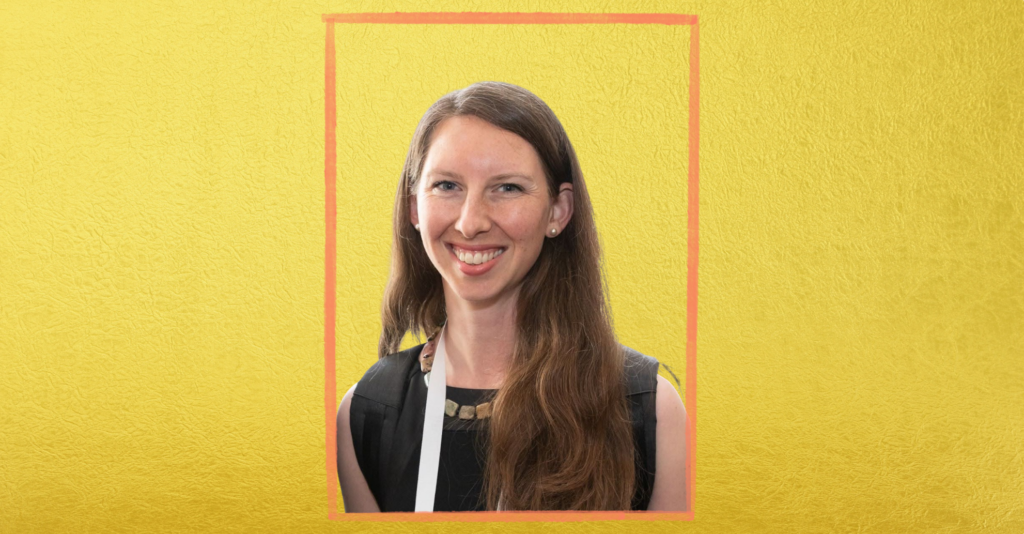
Dr Anna Riddell is at University of Tasmania alumna, graduating with a Bachelor of Surveying and Spatial Sciences (Honours) in 2011. She joined Geoscience Australia in 2012 as a Graduate Geodesist, developing a strong interest in understanding how the Earth changes shape and size in response to mass redistribution. She completed her PhD in Geomatic Engineering (Geodesy) in 2021, with research focused on crustal deformation of the Australian continent.
She is currently the Director, GNSS Analysis, within the Positioning Australia Program at Geoscience Australia, where her team is responsible for delivering precise positioning products and services that underpin national spatial reference frameworks and a wide range of scientific, engineering, and operational applications. In addition to her national role, Dr Riddell serves as Chair of the Australian Intergovernmental Committee on Surveying and Mapping (ICSM) Geodesy Working Group and as Vice‑President of the IAG Global Geodetic Observing System (GGOS). Anna also is engaged in the international geodetic community, including leadership and advocacy as the IAG Commission 3 ECS representative. From a professional standpoint, her involvement in IAG ECS aligns naturally with her broader leadership roles: combining operational responsibility with advocacy for sustainable capability, knowledge transfer, and international collaboration. Anna believes that engagement with ECS provides a mechanism to help shape an inclusive, resilient future workforce for geodesy.
Anna’s opinion on ECS challenges:
From an ECS perspective, several recurring challenges are evident across the global geodetic community:
- Career sustainability and visibility – Early career scientists often face short‑term contracts, fragmented career pathways, and limited visibility of international decision‑making structures.
- Access to infrastructure and data – Participation in cutting‑edge geodesy increasingly depends on access to high‑quality data, computational resources, and observing systems, which are unevenly distributed globally.
- Representation, diversity, and inclusion – Ensuring ECS voices are meaningfully represented across geography, gender, and institutional contexts remains an ongoing challenge.
- Bridging science and operations – ECS frequently navigate the tension between academic outputs and operational or service‑oriented geodesy, requiring broader skill sets and mentorship.
- Community and mentorship – Strong international networks, mentoring, and peer support are critical but not always systematically embedded in professional structures.
Addressing these challenges requires sustained commitment from senior leadership, clearer pathways for ECS participation in governance, and continued investment in inclusive, international collaboration.