
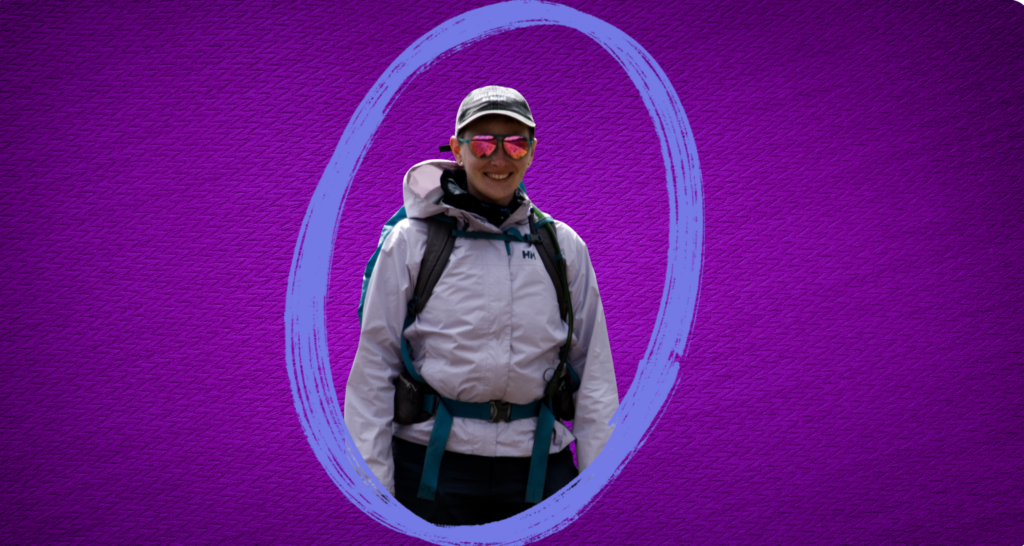
Catheryn Ryan is a postdoctoral associate working in the Department of Earth Sciences at the State University of New York at Buffalo in Buffalo, NY, USA. They study lava-ice interactions using experiments (pouring melted basalt over ice blocks), fieldwork (visiting subglacial volcanoes in Iceland), and lab-based methods (petrography and geochemistry). Catheryn’s PhD work at the University of Western Ontario (Canada) was at the intersection of geomicrobiology/astrobiology and volcanology: looking at microscopic traces of life in altered volcanic glass from Mars-like hydrovolcanic environments. They have a strong interest in planetary analogue studies, astrobiology on Mars, and hydro- and glaciovolcanism.
Catheryn began volunteering with the IAVCEI Early Career Researchers Network (ECR-Net) in the fall of 2025, and currently acts as a DEI officer. They wanted to become involved with IAVCEI after attending a joint IAVCEI-IACS Volcano-Ice Interactions Commission field workshop in Iceland in 2025 and seeing the amazing work that other PhD students, post-docs, and early professors put into the workshop. Catheryn is passionate about representing the experiences of queer and gender-diverse scientists in the broader scientific community, and also believes strongly in approaching geology from a decolonial standpoint.
Catheryn’s opinion on ECS challenges:
As an early career scientist, Catheryn finds the balance between trying to advance a career without having to be completely uprooted from a geographic area particularly challenging. Postdoctoral, research associate, and faculty positions are few and far-between as-is, especially with decreases in public research funding and shifts in funding priorities. The assumption that a researcher should be able to move anywhere, including internationally, including for a short-term position, is difficult to reconcile with having a stable life for a relationship or family, or building a community. The paucity of local opportunities and the frowned-upon nature of staying in one place for too long as an early-career scientist is detrimental to the advancement of research, and leads to burn-out as researchers have to either make significant personal sacrifices (moving far from family; ending or straining relationships) or career sacrifices (choosing not to apply to far-away jobs; leaving academia for more stable, local employment).